
💊 Clarithromycin (Clarithromycin)
Clarithromycin is an oral macrolide antibiotic used to treat mild to moderate infections caused by susceptible bacteria. It should be used only for infections that are proven or strongly suspected to be bacterial, to reduce the development of drug-resistant bacteria.
In Arabic: كلاريثروميسين
🏷️ Brand names & manufacturers
Packages shown are US-market (DailyMed). Brands available in Palestine are in the price section below. Clarithromycin🏭 Rising Pharma Holdings, Inc.
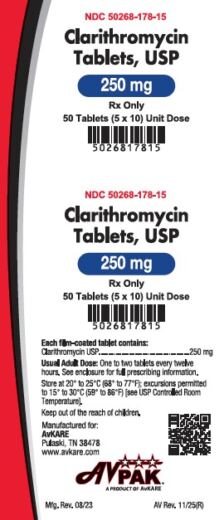 Clarithromycin🏭 AvPAK
 Clarithromycin🏭 Sandoz Inc
✅ What it is used for
- Acute bacterial exacerbation of chronic bronchitis in adults
- Acute maxillary sinusitis
- Community-acquired pneumonia
- Pharyngitis/tonsillitis (as an alternative when first-line therapy cannot be used)
- Uncomplicated skin and skin structure infections
- Acute otitis media in pediatric patients
- Treatment and prophylaxis of disseminated mycobacterial infections
- Helicobacter pylori infection and duodenal ulcer disease in adults
🧪 Active ingredient
Clarithromycin: a semi-synthetic macrolide antibiotic active against susceptible bacteria.
🌿 Benefits
- Treats mild to moderate bacterial infections of the respiratory tract, skin, and middle ear
- Can be taken with or without food
- Part of H. pylori eradication regimens to reduce the risk of duodenal ulcer recurrence
📝 How to use
- Taken by mouth, with or without food.
- The dose and duration are set by your doctor or pharmacist based on the infection and your condition; do not change them on your own.
- Complete the full course prescribed even if symptoms improve.
- For H. pylori, it is given together with other medicines (e.g., amoxicillin and a proton pump inhibitor) as directed by the doctor.
💊 Dosage forms
- Tablets 250 mg
- Tablets 500 mg
⚠️ Common side effects
- Abdominal pain
- Diarrhea
- Nausea
- Vomiting
- Altered taste (dysgeusia)
- Dyspepsia
- Abnormal liver function tests
- Headache
- Insomnia
- Rash
- Candidiasis
🚨 Serious — seek medical help
- Severe hypersensitivity reactions (anaphylaxis, Stevens-Johnson syndrome, toxic epidermal necrolysis, DRESS) – stop the drug immediately and seek emergency care
- QT prolongation and arrhythmia (including torsades de pointes)
- Hepatotoxicity (hepatitis, jaundice) – stop and contact your doctor
- Clostridium difficile-associated diarrhea
- Exacerbation of myasthenia gravis
- Myopathy/rhabdomyolysis when combined with certain statins
⛔ Do not use if
- Hypersensitivity to clarithromycin or any macrolide (e.g., erythromycin)
- Concomitant use with cisapride or pimozide
- History of cholestatic jaundice or hepatic dysfunction with prior clarithromycin use
- Concomitant colchicine in patients with renal or hepatic impairment
- Concomitant lomitapide, lovastatin, or simvastatin
- Concomitant ergot alkaloids (ergotamine, dihydroergotamine)
- Concomitant lurasidone
❗ Warnings & precautions
- Avoid in patients with known QT prolongation, ventricular arrhythmia, those taking QT-prolonging drugs, or with hypokalemia/hypomagnesemia or significant bradycardia
- Increased all-cause mortality has been observed one year or more after treatment in patients with coronary artery disease; the prescriber should weigh this risk against benefit
- Discontinue if signs of hepatitis or a severe hypersensitivity reaction occur
- Serious interactions can occur with colchicine, some lipid-lowering agents, some calcium channel blockers, and other drugs
- Evaluate any diarrhea that occurs during or after treatment
- Dose reduction is advised in moderate renal impairment with concomitant atazanavir or ritonavir-containing regimens, and in severe renal impairment
🔄 Drug interactions
- Colchicine (contraindicated in renal/hepatic impairment)
- Lovastatin, simvastatin, lomitapide (contraindicated)
- Cisapride and pimozide (contraindicated)
- Ergot alkaloids (contraindicated)
- Lurasidone (contraindicated)
- Antiarrhythmics: disopyramide, quinidine, dofetilide, amiodarone, sotalol, procainamide (not recommended)
- Digoxin (use with caution; levels may increase)
- Carbamazepine and other CYP3A substrates (use with caution and monitor concentrations)
- Calcium channel blockers such as verapamil, amlodipine, diltiazem, nifedipine
- Atazanavir and ritonavir-containing regimens (dose adjustment in renal impairment)
🤰 Pregnancy
Clarithromycin is not recommended in pregnancy except where no alternative therapy is appropriate, based on animal findings (cardiovascular anomalies in rats, cleft palate in mice). If pregnancy occurs during treatment, the patient should be informed of the potential hazard to the fetus.
🍼 Breastfeeding
The provided label text does not contain breastfeeding information; consult your doctor or pharmacist before use while breastfeeding.
🧒 Children
Safety and effectiveness of the tablets are established in patients 6 months and older for pharyngitis/tonsillitis, community-acquired pneumonia, acute maxillary sinusitis, acute otitis media, and uncomplicated skin infections, and for prevention of disseminated MAC in patients 20 months and older with advanced HIV infection. Safety and effectiveness under 6 months have not been established. The doctor sets the weight-based dose.
👴 Older adults
Clarithromycin concentrations are higher in elderly patients, in line with age-related decline in renal function; dose adjustment should be considered in severe renal impairment. Elderly patients may be more susceptible to torsades de pointes, acute kidney injury with certain calcium channel blockers, and colchicine toxicity.
🌡️ Storage
Store at controlled room temperature 20° to 25°C (68° to 77°F) in a well-closed container.
⏰ Missed dose
The provided label text does not address missed doses; ask your doctor or pharmacist and do not double the dose on your own.
🆘 Overdose
Overdose can cause gastrointestinal symptoms such as abdominal pain, vomiting, nausea, and diarrhea. Treatment involves prompt elimination of unabsorbed drug and supportive measures; serum concentrations are not expected to be appreciably affected by hemodialysis or peritoneal dialysis. Seek emergency care or a poison center immediately.
💰 Price & brands in your area
🏛️ Official price in Palestine — Ministry of Health price list:
| Product | Company | Pack | Price |
|---|---|---|---|
| klacid susp 125 MG /5 ML CLARITHROMYCIN | MSS | 60 ML | 27 ₪ |
| KLARICARE XL 500 EXTENDED RELEASE TABLETS (7 TAB) Clarithromycin 500mg | Pharmacare Company | 7 TABLETS / BOX | 40 ₪ |
| KLARIMAX 500 TAB CLARITHROMYCIN 500MG/TABLET | Beit Jala | 14 caplet | 45 ₪ |
| KLARICARE 500 MG TABLETS (15 TAB) Clarithromycin500mg | Pharmacare Company | 15 TABLETS / BOX | 60 ₪ |
| PEPTIPAC EACH: CAPSULE CONTAINS 20 MG OMEPRAZOLE. TABLET CONTAINS 1000 MG AMOXICILLIN. T | Pharmacare Company | 28 TABLETS AND 14 CAPSULES= 42 TABLETS AND CAPSULES / BOX | 85 ₪ |
📍 Find the nearest pharmacy
Your location is used only in your browser to show nearby pharmacies — we don't store it.
Open in Google Maps👨⚕️ For healthcare professionals
Mechanism of action
Clarithromycin (6-O-methylerythromycin) is a semi-synthetic macrolide antimicrobial and an inhibitor of CYP3A4/CYP3A and P-glycoprotein.
Labeled dosing
Label adult dosing: 250 or 500 mg every 12 hours for 7–14 days depending on indication. H. pylori eradication: 500 mg every 8 or 12 hours for 10–14 days in combination regimens. Pediatric: 15 mg/kg/day divided every 12 hours for 10 days. May be given with or without food. The final dose is determined by the doctor or pharmacist.
- Reduce dose in moderate renal impairment with concomitant atazanavir or ritonavir-containing regimens, and in severe renal impairment.
- Absolute bioavailability of the tablet is ~50%; food does not affect extent of bioavailability.
- Half-life is ~3–4 hours with 250 mg every 12 hours and 5–7 hours with 500 mg every 8–12 hours.
- Serum concentrations are not expected to be appreciably affected by hemodialysis or peritoneal dialysis.
🎓 Key points for students
- Clarithromycin is a semi-synthetic macrolide that inhibits CYP3A4 and P-gp, raising levels of drugs cleared by these pathways.
- Key contraindications: cisapride, pimozide, lovastatin, simvastatin, lomitapide, ergot alkaloids, lurasidone, and colchicine in renal/hepatic impairment.
- Major risks: QT prolongation/torsades de pointes, hepatotoxicity, severe hypersensitivity, CDAD, myasthenia gravis exacerbation.
- Most common adverse effects are gastrointestinal: abdominal pain, diarrhea, nausea, vomiting, dysgeusia.
EME runs your whole clinic: appointments with WhatsApp reminders, patient files, finance & inventory, a patient portal and a members-price medical store — with your data isolated and protected.
Try EME free How we protect your data❓ FAQ
What is clarithromycin used for?
It treats mild to moderate bacterial infections such as sinusitis, community-acquired pneumonia, skin infections, and otitis media in children, and is used in combination regimens for H. pylori infection.
Can it be taken with food?
Yes, the tablets can be taken with or without food.
What are the common side effects?
Abdominal pain, diarrhea, nausea, vomiting, and altered taste; headache, insomnia, and rash may also occur.
Can I take it with other medicines?
Not without checking first. It interacts with many drugs, some of which are contraindicated (e.g., simvastatin, lovastatin, colchicine in certain patients, cisapride, pimozide). Tell your doctor about everything you take.
Is it safe in pregnancy?
It is not recommended in pregnancy unless no suitable alternative exists and your doctor decides it is necessary.
When should I seek medical help right away?
If you develop a severe rash, swelling, trouble breathing, yellowing of the skin or eyes, palpitations or fainting, or severe or persistent diarrhea.
⚕️ For education only — not a substitute for advice from your doctor or pharmacist. Do not start or stop any medicine without advice. Source: official FDA drug label via openFDA (2026-04), simplified. Updated: 2026-11-10.