
💊 Candesartan (Candesartan)
Candesartan is an oral angiotensin II receptor blocker used to treat hypertension in adults and children 1 to <17 years of age, and to treat heart failure (NYHA class II-IV). It carries a boxed warning for fetal toxicity and must be discontinued as soon as pregnancy is detected.
In Arabic: كانديسارتان (كانديسارتان سيليكسيتيل)
🏷️ Brand names & manufacturers
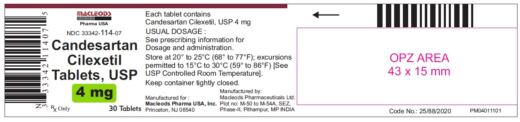 Candesartan🏭 Macleods Pharmaceuticals LimitedDailyMed
✅ What it is used for
- Treatment of hypertension in adults and children 1 to <17 years to lower blood pressure
- Lowering blood pressure reduces the risk of fatal and non-fatal cardiovascular events, primarily strokes and myocardial infarctions
- Treatment of heart failure (NYHA class II-IV) to reduce cardiovascular death and heart failure hospitalization
🧪 Active ingredient
The active ingredient is candesartan cilexetil, a prodrug hydrolyzed to active candesartan during absorption from the gastrointestinal tract. It blocks angiotensin II from binding to the AT1 receptor, preventing its vasoconstrictor and aldosterone-secreting effects.
🌿 Benefits
- Lowers high blood pressure
- Reduces the risk of stroke and heart attack
- Reduces cardiovascular death and heart failure hospitalization in heart failure patients
📝 How to use
- The dose and duration are set by your doctor or pharmacist for your condition; do not change it yourself
- Tablets may be taken with or without food
- May be given once or twice daily as directed by your doctor
- Most of the blood pressure-lowering effect occurs within 2 weeks, with maximal effect generally within 4 to 6 weeks
- A diuretic or other blood pressure medicines may be added by your doctor if blood pressure is not controlled
💊 Dosage forms
- 4 mg tablets (white to off-white, debossed "ML 52")
- 8 mg tablets (light pink, debossed "ML 53")
- 16 mg tablets (pink, debossed "ML 54")
- 32 mg tablets (pink, debossed "ML 55")
⚠️ Common side effects
- Headache
- Dizziness
- Back pain
- Upper respiratory tract infection
- Pharyngitis
- Rhinitis
- Low blood pressure (especially in heart failure patients)
🚨 Serious — seek medical help
- Angioedema (swelling of face, lips, tongue or throat)
- Symptomatic hypotension
- Abnormal renal function
- Hyperkalemia
- Hyponatremia
- Abnormal hepatic function and hepatitis
- Neutropenia, leukopenia and agranulocytosis
⛔ Do not use if
- Hypersensitivity to candesartan or any product component
- Do not co-administer with aliskiren in patients with diabetes
- Must not be given to children <1 year of age for hypertension
❗ Warnings & precautions
- Boxed warning: fetal toxicity; discontinue as soon as pregnancy is detected because drugs acting on the renin-angiotensin system can cause injury and death to the developing fetus
- Can cause symptomatic hypotension, particularly in volume- and/or salt-depleted patients (prolonged diuretic therapy, salt restriction, dialysis, diarrhea, vomiting); correct depletion before starting
- Monitor renal function and potassium levels
- Monitor blood pressure during dose escalation and periodically thereafter
- Children <1 year must not receive it; pediatric patients with GFR <30 mL/min/1.73m² should not receive it since it has not been studied
- Initiate at 8 mg in moderate hepatic insufficiency; no dosing recommendation for severe hepatic insufficiency
- Inform your doctor before major surgery or anesthesia
🔄 Drug interactions
- Agents increasing serum potassium (potassium-sparing diuretics, potassium supplements, potassium-containing salt substitutes): risk of hyperkalemia
- Lithium: increased serum lithium concentrations and toxicity; monitor lithium levels
- NSAIDs including COX-2 inhibitors: may worsen renal function and attenuate the antihypertensive effect, especially in the elderly or volume-depleted
- Dual blockade of the RAS with ACE inhibitors, ARBs or aliskiren: increased risk of hypotension, hyperkalemia and renal changes
- Triple combination with an ACE inhibitor and a mineralocorticoid receptor antagonist is generally not recommended
- May be given with other antihypertensive agents as directed by your doctor
🤰 Pregnancy
The drug can cause fetal harm, particularly in the second and third trimesters (reduced fetal renal function, oligohydramnios, lung hypoplasia, skeletal deformations including skull hypoplasia, hypotension and death). If pregnancy is detected, discontinue as soon as possible and consult your doctor.
🍼 Breastfeeding
Either nursing or the drug should be discontinued, as decided by your doctor; consult your doctor before use while breastfeeding.
🧒 Children
Used for hypertension in children 1 to <17 years at doses set by the doctor (oral suspension for ages 1 to <6 years). Must not be given to children <1 year. Should not be used in children with GFR <30 mL/min/1.73m².
👴 Older adults
The provided label text contains no specific elderly dosing information. Caution is noted with NSAID co-administration in the elderly, as it may worsen renal function.
🌡️ Storage
Store at 20° to 25°C (excursions permitted 15° to 30°C). Keep container tightly closed.
⏰ Missed dose
The provided label text does not address missed doses. Ask your doctor or pharmacist what to do.
🆘 Overdose
The most likely manifestations are hypotension, dizziness and tachycardia; bradycardia could occur. Symptomatic hypotension is managed with supportive treatment. Candesartan cannot be removed by hemodialysis. If overdose is suspected, contact a poison control center or seek medical care immediately.
💰 Price & brands in your area
🏛️ Official price in Palestine — Ministry of Health price list:
| Product | Company | Pack | Price |
|---|---|---|---|
| ATACAND 8 MG-28 TAB CANDESARTAN CILEXETIL | TRANSMED PHARMA | 28 TAB | 24 ₪ |
| ATACAND 16 MG-28 TAB CANDESARTAN CILEXETIL | TRANSMED PHARMA | 28 TAB | 33 ₪ |
| ATACAND PLUS 16/12.5 MG-28 TAB Candesartan Cilexetil & Hydrochlorothiazide | TRANSMED PHARMA | 28 TAB | 35 ₪ |
| CANDEPLUS 32/25 - 30 TAB Candesartan Cilexetil & Hydrochlorothiazide | Jepharm Co. | 30 TAB | 60 ₪ |
📍 Find the nearest pharmacy
Your location is used only in your browser to show nearby pharmacies — we don't store it.
Open in Google Maps👨⚕️ For healthcare professionals
Mechanism of action
Selective AT1 angiotensin II receptor antagonist (>10,000-fold greater affinity for AT1 than AT2), blocking vasoconstriction and aldosterone secretion independent of angiotensin II synthesis pathway; does not inhibit ACE so bradykinin response is unaffected. The prodrug candesartan cilexetil is hydrolyzed to candesartan during absorption.
Labeled dosing
Adult hypertension: usual starting dose 16 mg once daily as monotherapy in non-volume-depleted patients; total daily dose 8-32 mg once or twice daily. Heart failure: start 4 mg once daily, target 32 mg once daily by doubling at ~2-week intervals as tolerated. Moderate hepatic insufficiency: start 8 mg. The dose is individualized and set by the doctor/pharmacist.
- Blood pressure response is dose-related over 2-32 mg; larger doses do not appear to have a greater effect
- May be taken with or without food
- Correct volume/salt depletion before initiation; monitor BP, renal function and potassium
- In CHARM, hypotension occurred in 18.8% vs 9.8% on placebo, leading to discontinuation in 4.1% vs 2.0%
- Most common reasons for discontinuation in heart failure: hypotension (4.1%), abnormal renal function (6.3%), hyperkalemia (2.4%)
- Most common reasons for discontinuation in hypertension: headache (0.6%) and dizziness (0.3%)
🎓 Key points for students
- Class: angiotensin II receptor blocker (ARB); prodrug converted to candesartan
- Mechanism: AT1 receptor blockade without ACE inhibition or bradykinin effect
- Boxed warning: fetal toxicity in 2nd/3rd trimester (oligohydramnios, lung hypoplasia, skull hypoplasia)
- Common adverse effects: headache, dizziness, back pain, upper respiratory infections
- Key interactions: potassium, lithium, NSAIDs, dual RAS blockade
- Contraindications: hypersensitivity, aliskiren in diabetes, children <1 year
EME runs your whole clinic: appointments with WhatsApp reminders, patient files, finance & inventory, a patient portal and a members-price medical store — with your data isolated and protected.
Try EME free How we protect your data❓ FAQ
What is candesartan used for?
It treats hypertension in adults and children 1 to <17 years, and heart failure to reduce cardiovascular death and hospitalization.
How long does it take to work?
Most of the blood pressure-lowering effect appears within 2 weeks, with maximal effect generally within 4 to 6 weeks.
Can it be taken during pregnancy?
No. It can cause fetal harm and must be discontinued as soon as pregnancy is detected; consult your doctor.
Should it be taken with food?
Tablets may be taken with or without food; the dose is determined by your doctor.
What are the main side effects?
Headache, dizziness, back pain, upper respiratory infections and low blood pressure. Tell your doctor right away if you notice swelling of the face or throat.
Can I take it with NSAIDs like ibuprofen?
NSAIDs may worsen kidney function and reduce candesartan's effect; ask your doctor or pharmacist before combining them.
⚕️ For education only — not a substitute for advice from your doctor or pharmacist. Do not start or stop any medicine without advice. Source: official FDA drug label via openFDA (2022-12), simplified. Updated: 2026-11-11.